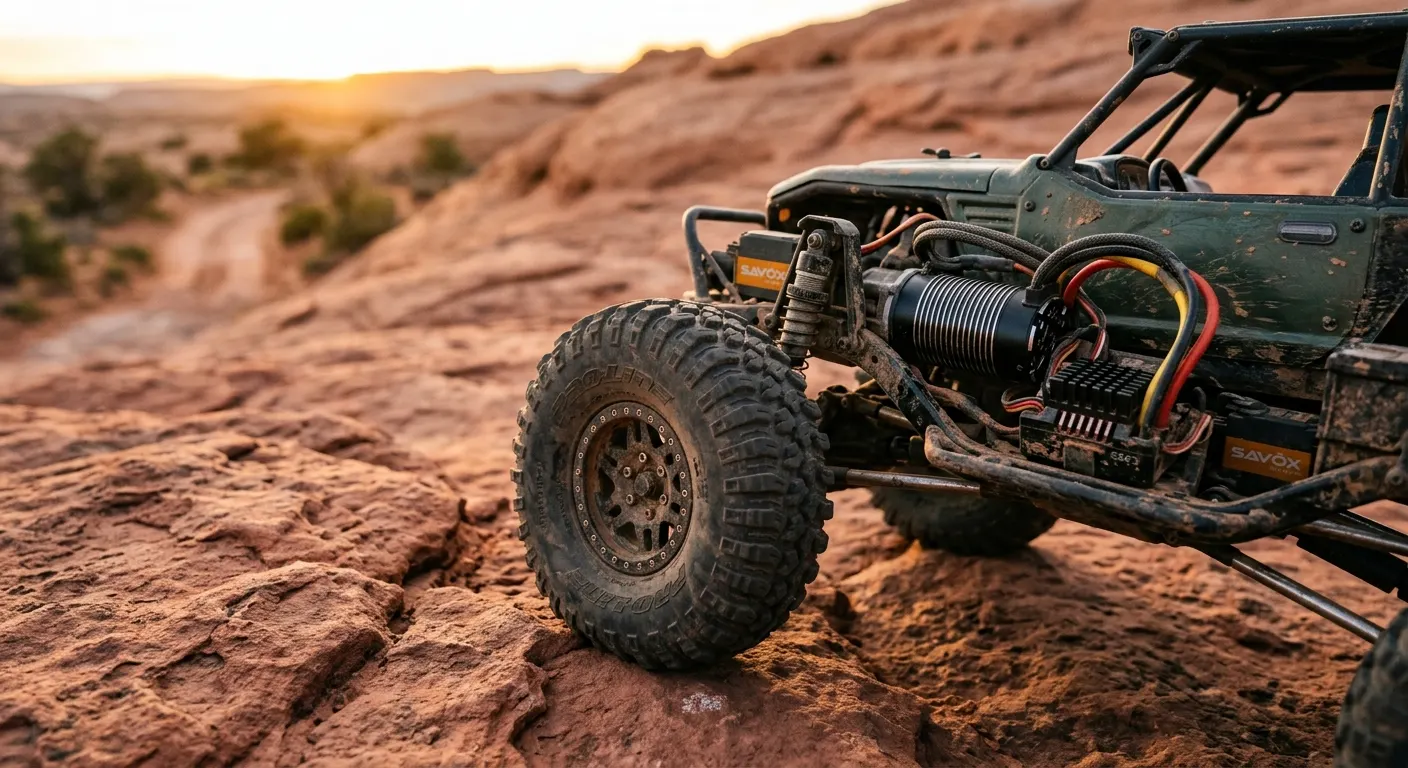
Brushless conversion is the most discussed upgrade in the RC crawler hobby and one of the most misunderstood. Choosing the wrong KV motor or an ESC without proper drag brake makes the rig harder to control on the trail, not easier. Getting it right means understanding what KV means at crawling speeds, why sensored motors matter at very low RPM, and how drag brake should be set for different terrain. This guide covers all of that and links to the specific electronics combinations worth buying for SCX10 and TRX-4 builds in 2026.
Quick answer
The Hobbywing QuicRun Fusion 2-in-1 brushless system is the best single-purchase brushless upgrade for SCX10 and TRX-4 crawlers, pairing a sensored 1800KV motor with a crawler-specific ESC and waterproof housing. For a budget brushless setup, the GLOBACT 3542 1450KV motor paired with the AM32 80A ESC delivers real crawling performance for significantly less than the Fusion price.
This guide contains affiliate links. CrawlKin may earn a commission at no cost to you.
What KV rating should a crawler motor have?
KV is the number of RPM the motor produces per volt of input with no load. Lower KV means more torque per amp at a given voltage. Rock crawling requires maximum torque at very low speeds, not high RPM.
For a 1/10 crawler running 2S (7.4V), most builders settle on motors in the 1400 to 2000KV range. A 1800KV motor on 2S produces enough torque for most trail and competition terrain while keeping the rig at a manageable crawling speed through the gearbox. Going lower KV (1200 to 1400) on 2S gives even more torque and a slower natural speed, which suits technical rock sections. Going higher (above 2200KV on 2S) starts pushing the rig toward a speed that becomes difficult to control on steep terrain.
On 3S (11.1V), the same RPM per volt means the motor runs at 50 percent higher base speed. A 3S build should use a motor in the 800 to 1400KV range to keep crawling speeds in a similar range to a 2S 1800KV setup.
The Hobbywing QuicRun Fusion 2-in-1 Brushless System 1800KV includes a sensored 1800KV motor paired to a crawler ESC: the right voltage and KV choice already made in a pre-matched system for 2S operation.

Hobbywing QuicRun Fusion 2-in-1 Brushless System 1800KV
The most-recommended brushless upgrade for 1/10 crawlers. Sensored 1800KV motor integrated with crawler-spec ESC in a single waterproof unit with adjustable drag brake and smooth low-speed control.
Sensored versus sensorless: why it matters more for crawling
A sensored brushless motor has position sensors in the stator that feed precise rotor angle data to the ESC. The ESC uses that data to commutate the motor with precision at any RPM, including near-zero. A sensorless motor has no sensors, so the ESC must estimate rotor position from back-EMF, which only works reliably above a certain minimum speed.
At crawling speeds, a sensorless motor cogges: it steps in discrete jerks rather than moving smoothly. On a steep rock face where you are feeding in minimal throttle to move the rig slowly, cogging is the difference between precise and chaotic. A sensored system feels like a completely different driving experience at low speed.
The Hobbywing QuicRun Fusion SE uses FOC (Field Oriented Control) with sensors, which is the current standard for smooth crawling electronics. FOC is noticeably smoother, particularly in the first few degrees of throttle movement where crawling precision matters most.
The GLOBACT 3542 1450KV Brushless Crawler Motor is a low-cogging sensorless design that performs better than typical sensorless alternatives at low RPM, but it still shows some stepping compared to a full sensored FOC system. It is the budget tradeoff: real brushless performance improvement over brushed at a lower price, with some loss of the silky-smooth ultra-low-speed control that sensored FOC delivers.

GLOBACT 3542 1450KV Brushless Crawler Motor
Low-KV sensorless brushless motor designed for 1/10 crawlers. 3542 can size fits standard SCX10 and TRX-4 motor bays with low-cogging design for smoother low-speed delivery.
ESC features that matter for crawling: drag brake and throttle shaping
Drag brake is the ESC feature that simulates engine braking on a full-size 4WD. When you release the throttle, the ESC applies a braking force proportional to the drag brake setting rather than letting the motor freewheel. On a downhill, this holds the rig in place without running the motor or touching the brakes.
Most crawler ESCs allow drag brake adjustment from 0 to 100 percent. For steep rock terrain, many builders run 80 to 100 percent drag brake. On smoother trail terrain with gentle downhills, lower drag brake settings (40 to 60 percent) give a more natural feel.
Throttle shaping controls how quickly the ESC ramps from zero to full power as you advance the trigger. A sharp throttle curve makes precise low-speed inputs harder because a tiny trigger movement produces a large power change. A gentle crawl curve spreads that power change across a wider trigger movement, making slow precise inputs easier.
The AM32 80A Brushless ESC for 1/10 Crawler (USB Programmable) uses open-source AM32 firmware with USB programmability for full parameter access including drag brake level, throttle curve shape, and motor timing.
The Hobbywing QuicRun WP 1080 Waterproof Brushed Crawler ESC is the correct ESC upgrade for stock-motor builds: adjustable drag brake in ten levels via program card, multiple crawl throttle modes, and full waterproofing.

AM32 80A Brushless ESC for 1/10 Crawler (USB Programmable)
Open-source AM32 firmware ESC with 80A continuous rating, USB programming via linker, and crawler-appropriate features including drag brake and low-speed throttle shaping.

Hobbywing QuicRun WP 1080 Waterproof Brushed Crawler ESC
The most recommended waterproof brushed ESC upgrade for stock-motor crawlers. 80A continuous, adjustable drag brake, multiple crawl modes, and a plug-in program card interface.
The all-in-one option versus separate motor and ESC
The Hobbywing QuicRun Fusion 2-in-1 Brushless System 1800KV integrates motor and ESC into a single waterproof housing. The advantages are a single unit to mount with simplified wiring, an integrated heat management path, and a pre-matched motor and ESC combination that Hobbywing has validated for crawling performance.
Separate motor plus ESC combinations give you component flexibility. You can upgrade the ESC without changing the motor, or swap to a different KV motor while keeping the ESC. For builders who want to tune the build over time, separate components are more flexible.
The budget brushless combination of the GLOBACT 3542 1450KV Brushless Crawler Motor with the AM32 80A Brushless ESC for 1/10 Crawler (USB Programmable) costs significantly less than the Fusion while delivering a real brushless performance step up from any stock brushed system.
For most SCX10 and TRX-4 owners doing their first brushless conversion, the Fusion system is the lower-friction choice. For hobbyists who enjoy the electronics tuning side of the hobby, the separate combination gives more to work with.
Hobbywing QuicRun Fusion 2-in-1 Brushless System 1800KV
The most-recommended brushless upgrade for 1/10 crawlers. Sensored 1800KV motor integrated with crawler-spec ESC in a single waterproof unit with adjustable drag brake and smooth low-speed control.
GLOBACT 3542 1450KV Brushless Crawler Motor
Low-KV sensorless brushless motor designed for 1/10 crawlers. 3542 can size fits standard SCX10 and TRX-4 motor bays with low-cogging design for smoother low-speed delivery.
AM32 80A Brushless ESC for 1/10 Crawler (USB Programmable)
Open-source AM32 firmware ESC with 80A continuous rating, USB programming via linker, and crawler-appropriate features including drag brake and low-speed throttle shaping.
Servo: the overlooked electronics upgrade
No brushless motor upgrade fully compensates for a servo that strips under load. The increased torque of a brushless system through the gearbox puts more load on the front axle, which puts more load on the steering servo. If the servo was at its limit before brushless, it will fail faster after.
At minimum, do the servo upgrade at the same time as the brushless conversion. The Savox SW-1210SG Waterproof Steel Gear Servo is the servo competition crawlers trust: 444 oz-in of torque, IP67 waterproofing, and no buzz on steep hold angles. The ANNIMOS DS3225 PRO 35KG Waterproof Digital Servo is the budget option that delivers stainless steel gears and IP66 water resistance for under $25.
For 3S brushless builds, metal gears are non-negotiable. The increased motor torque creates proportionally higher steering loads when the front wheels contact obstacles. Brass gear servos do not survive long in this combination.

Savox SW-1210SG Waterproof Steel Gear Servo
High-torque steel gear waterproof servo trusted by competition crawlers. 444 oz-in of torque, IP67 waterproof rating, and no buzzing on steep off-camber sections.

ANNIMOS DS3225 PRO 35KG Waterproof Digital Servo
IP66 waterproof servo with stainless steel gears delivering 35 kg-cm at 7.4V. Over 1,500 positive reviews and consistently rated a top budget servo for 1/10 crawlers.
Battery selection for brushless builds
A brushless 2S build runs the same Zeee 2S 5200mAh 7.4V 50C LiPo Battery with XT60 (pair) or Ovonic 2S 5000mAh 7.4V Shorty LiPo Battery 50C packs as a brushed 2S build. The brushless motor is more efficient at low crawling loads, so run time may actually improve slightly compared to a brushed system at the same capacity.
For 3S builds, the Gens Ace G-Tech 3S 5300mAh 11.1V LiPo Battery is the quality choice and the Zeee 3S 6200mAh 11.1V LiPo Battery Hard Case with XT60 adds maximum capacity in a rigid case. Pair either with the ISDT Q6 Plus 14A 300W LiPo Balance Charger , which handles 3S packs alongside 2S packs in a single charger platform.

Zeee 2S 5200mAh 7.4V 50C LiPo Battery with XT60 (pair)
The best-selling RC LiPo on Amazon in the crawler-relevant 2S size. Sold as a pair at a per-pack price that undercuts branded alternatives significantly.

Ovonic 2S 5000mAh 7.4V Shorty LiPo Battery 50C
Shorty form factor 2S pack for crawlers with tight battery trays. Ovonic consistently ranks among the value LiPo brands for run time and cycle life.
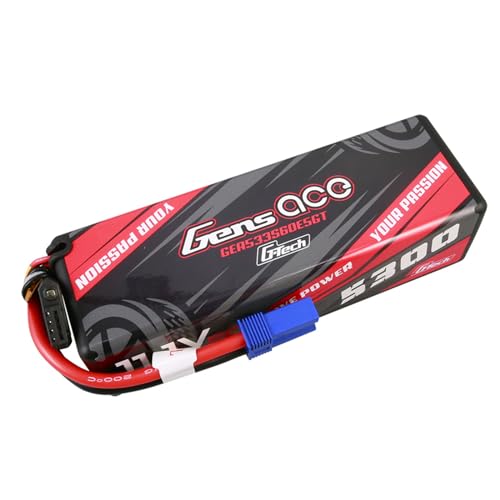
Gens Ace G-Tech 3S 5300mAh 11.1V LiPo Battery
Quality 3S pack from a brand with a long track record in hobby LiPo. Includes built-in smart sensor for compatible Gens Ace chargers. For crawlers running brushless systems on 3S.

Zeee 3S 6200mAh 11.1V LiPo Battery Hard Case with XT60
Hard-case 3S pack at 6200mAh for brushless crawler builds needing maximum run time. Rigid case prevents puffing and protects cells during chassis impacts.
ISDT Q6 Plus 14A 300W LiPo Balance Charger
Compact 14A capable balance charger that handles 1S to 6S LiPo, NiMH, and LiFe. Clear display, storage charge function, and internal resistance reading for detecting aging packs.
Hobbywing QuicRun Fusion 2-in-1 Brushless System 1800KV
The most-recommended brushless upgrade for 1/10 crawlers. Sensored 1800KV motor integrated with crawler-spec ESC in a single waterproof unit with adjustable drag brake and smooth low-speed control.
GLOBACT 3542 1450KV Brushless Crawler Motor
Low-KV sensorless brushless motor designed for 1/10 crawlers. 3542 can size fits standard SCX10 and TRX-4 motor bays with low-cogging design for smoother low-speed delivery.
AM32 80A Brushless ESC for 1/10 Crawler (USB Programmable)
Open-source AM32 firmware ESC with 80A continuous rating, USB programming via linker, and crawler-appropriate features including drag brake and low-speed throttle shaping.
Savox SW-1210SG Waterproof Steel Gear Servo
High-torque steel gear waterproof servo trusted by competition crawlers. 444 oz-in of torque, IP67 waterproof rating, and no buzzing on steep off-camber sections.
Hobbywing QuicRun WP 1080 Waterproof Brushed Crawler ESC
The most recommended waterproof brushed ESC upgrade for stock-motor crawlers. 80A continuous, adjustable drag brake, multiple crawl modes, and a plug-in program card interface.
FAQ
Frequently asked questions
What KV brushless motor is best for 1/10 rock crawling on 2S LiPo?+
Most 1/10 crawler builders settle on 1400 to 1800KV on 2S (7.4V). This range keeps crawling speeds manageable through the stock gearbox while delivering the torque that rock terrain demands. A 1800KV motor is a good starting point and matches the Hobbywing QuicRun Fusion system. Lower KV (1200 to 1400) suits very technical terrain where slower natural speeds are better.
Is a sensored brushless motor necessary for crawling?+
Strongly recommended. Sensored brushless motors give the ESC precise rotor position data, which eliminates the start-up cogging that sensorless motors exhibit at very low RPM. At crawling speeds where you are feeding in minimal throttle to move a few millimeters at a time, the difference between sensored and sensorless is significant. FOC (Field Oriented Control) sensored systems like the Hobbywing QuicRun Fusion are the current standard for smooth crawling performance.
What drag brake setting should I use on a crawler ESC?+
Most builders start with 80 percent drag brake for technical rock terrain and reduce it to 40 to 60 percent on smoother trail runs for a more natural driving feel. The correct setting depends on terrain steepness and personal preference. Adjust one level at a time and run the same section to feel the difference. Full drag brake (100 percent) can feel jerky on smooth terrain but is appropriate for steep descents.
Can I run the AM32 ESC without a computer?+
Some basic parameters can be set with the motor, but the AM32 firmware's full drag brake adjustment and throttle curve tuning require the USB linker and a computer running the AM32 configurator app. The app is free and the linker costs about $5. If you are not comfortable with USB-based setup, the Hobbywing QuicRun Fusion uses a physical program card interface that requires no computer.
Should I upgrade the servo when I do a brushless conversion?+
Yes. Upgrade the servo at the same session. Brushless motor torque delivered through the gearbox creates higher steering loads when the front wheels contact obstacles, and a servo that was borderline before brushless will fail faster after. Metal gear waterproof servos are the minimum requirement for a brushless crawler build.